
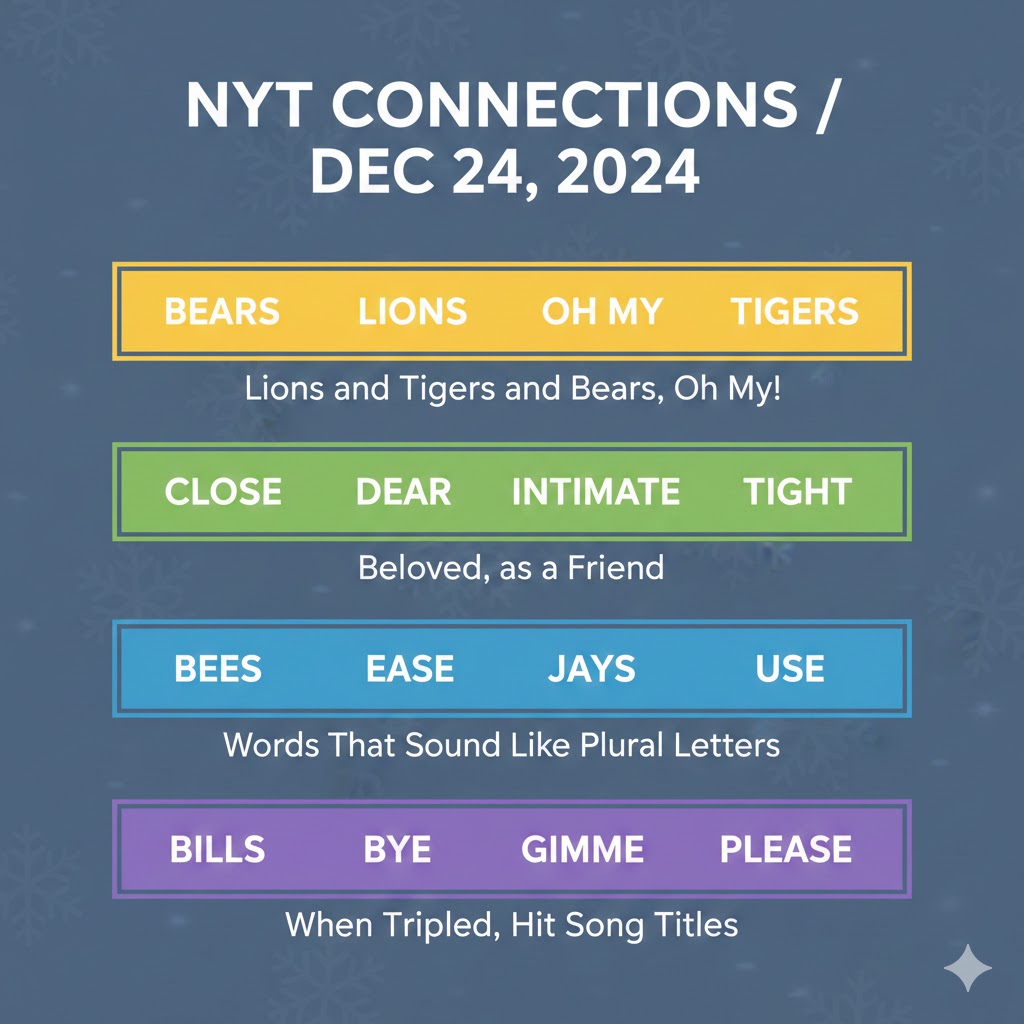

If you’re a fan of word games, chances are you’ve already spent some time with the New York Times’ Connections puzzle. It’s one of those games that feels simple at first but quickly turns into a brain-teaser that keeps you hooked for hours. Whether you’re a casual player or a dedicated puzzle solver, knowing how to approach the game can make a huge difference. In this article, we’ll explore everything you need to know about Connections Answers, how to think about grouping words, and some practical tips to improve your skills.
Understanding the NYT Connections Puzzle
The NYT Connections puzzle isn’t like crosswords or traditional word searches. Instead, it challenges you to identify four groups of related words from a set of 16. At first glance, the words may seem random, but with a little practice, patterns start to emerge.
For example, on December 24, 2025, the puzzle might feature words that are related to sports, science, literature, or even idioms. What makes it engaging is that there’s no single obvious answer, and you often find yourself reconsidering your choices as the puzzle progresses.
Many players enjoy keeping a small notebook nearby to jot down possible categories, while others prefer mental grouping. Either method works, as long as you stay organized.
How to Approach Grouping Words
One of the keys to solving the puzzle efficiently is recognizing patterns. Words are often linked in ways you might not expect, such as synonyms, categories, or common phrases.
Take an example: if you see words like “RASH,” “RUSH,” “SURGE,” and “WAVE,” your brain might immediately notice that these all relate to sudden increases or bursts. Seeing this connection early can help reduce the stress of guessing.
Another tip is to look for less obvious links. Sometimes, words that seem unrelated at first can share a cultural or historical reference. For instance, names from mythology or literature often show up, requiring a slightly broader knowledge base. The more you play, the easier these patterns become to spot naturally.
Why Some Words Trip You Up
It’s normal to get stuck on one or two words. Words can be tricky because they might belong to more than one possible group. For example, “SOFT SPOT” could be interpreted as a weakness in psychology or simply a literal soft area.
This is where Connections Answers guides come in handy. They provide clarity without giving away the entire puzzle at once. By checking a guide, you can confirm tricky groupings, learn new word associations, and gradually train yourself to notice subtle patterns on your own.
Real-Life Strategy for Better Puzzle Solving
Many players develop their own strategies over time. Some start by scanning all 16 words and immediately grouping the ones they recognize. Others prefer tackling obvious categories first and then focusing on the more ambiguous ones.
Personally, I like a hybrid approach. I pick out the words that scream “category” to me and then analyze the remaining ones. This method works well because it reduces the cognitive load. Over time, you’ll also notice that certain types of words recur across puzzles, making your brain more attuned to likely groupings.
Using Connections Answers Wisely
Checking Connections Answers after attempting a puzzle isn’t cheating—it’s a learning tool. When I first started, I often got frustrated by missing a single word. Looking at the answers afterward helped me understand why my choices were wrong and what types of connections I was overlooking.
Another good practice is to analyze past puzzles. Many websites and forums keep archives of solutions. Going through these can give you insight into recurring patterns and unexpected groupings. Over time, you’ll begin to predict the types of groups that appear frequently, which makes solving new puzzles faster and more satisfying.
Common Categories in the Puzzle
While the game prides itself on variety, some types of groupings appear more often:
- Synonyms: Words with similar meanings.
- Idioms or phrases: Multi-word expressions.
- Pop culture references: Names, movies, or books.
- Numbers or sequences: Days of the week, months, or number patterns.
- Science or nature: Animals, chemical elements, or phenomena.
By keeping these common categories in mind, you can speed up your problem-solving and improve accuracy. Recognizing patterns is half the fun, and it’s also the reason players keep coming back for more.
Tips for Beginners
If you’re new to NYT Connections, start slow. Don’t worry about finishing the puzzle in record time. Focus on:
- Scanning all words first: Understand your options before making a guess.
- Finding obvious groups: Even one or two complete groups helps reduce choices for the remaining words.
- Eliminating options: Cross out words that clearly do not belong together.
- Learning from mistakes: Use Connections Answers after your attempt to understand tricky groupings.
A little practice every day goes a long way. Over time, your mind will start recognizing patterns automatically, and what once seemed difficult will feel intuitive.
Why the Puzzle is So Addictive
It’s more than just wordplay. The puzzle gives a satisfying mix of challenge and achievement. Completing all four groups successfully creates a small but powerful feeling of victory, which is why so many people enjoy starting or ending their day with it.
Plus, it encourages learning. You might come across words or references you’ve never heard before, and that’s part of the fun. By checking Connections Answers occasionally, you turn every challenge into a mini-lesson, expanding your vocabulary and cultural knowledge in a subtle, enjoyable way.
Frequently Asked Questions (FAQs)
Q1: Are there always four groups in every Connections puzzle?
Yes. Each puzzle has 16 words divided into four groups of four. The challenge is identifying the connections correctly.
Q2: Can I use hints or answers without ruining the fun?
Absolutely. Many players attempt the puzzle first and then check Connections Answers to learn from mistakes. It’s a learning tool, not a cheat.
Q3: Do the categories repeat over time?
Some do, like synonyms, idioms, or pop culture references. Recognizing patterns helps improve speed and accuracy.
Q4: How long should I spend on a single puzzle?
It depends on your skill level. Beginners might take 15–20 minutes, while experienced solvers can finish in under 5.
Q5: Are online guides reliable for daily puzzles?
Yes. Most sites provide correct answers and explanations. They’re helpful for understanding tricky words and improving your strategy.
Conclusion
The NYT Connections puzzle is more than just a pastime; it’s a daily mental workout that sharpens your thinking and expands your vocabulary. Using Connections Answers strategically allows you to learn patterns, understand tricky words, and enjoy the puzzle more. Whether you’re playing for fun or trying to improve your skills, the challenge and satisfaction of completing the puzzle make it a rewarding experience every day.


